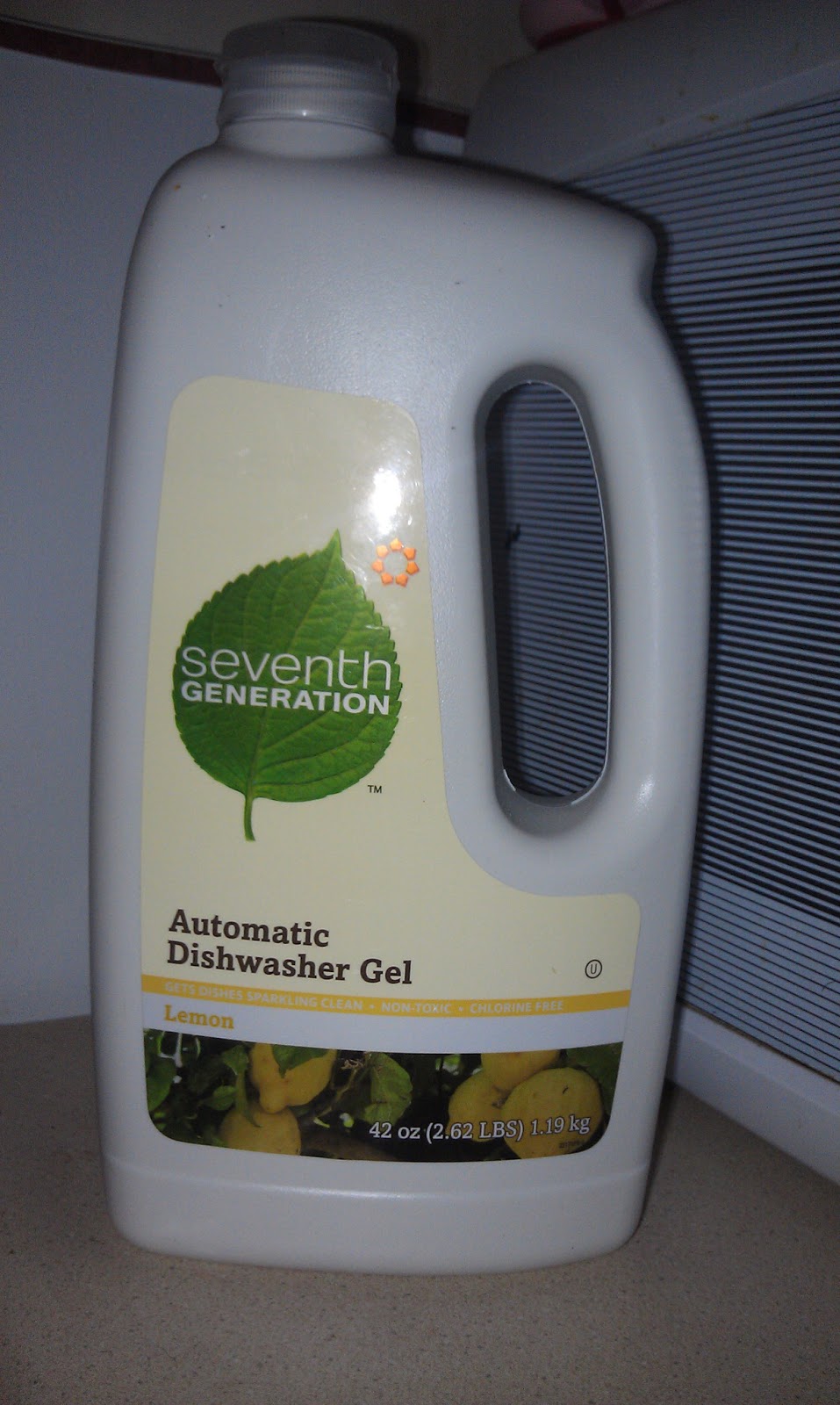
I do a lot of dishes and when I say a lot I mean I pretty much have to do them every day. Frequently I do more than one load a day. Dish-washing detergent is another one of those extra expenses I've just been living with.
Having long-since switched to an ecologically safe brand I could at least take solace in that fact. Not having to run out and buy more whenever I run out would be even nicer though.
I've tried other pins about making your own dish-washing detergent and have so far been left feeling incredibly unimpressed. This one is supposed to gel - a trait I found promising.
Today's pintest comes via this pin and the info found here.
Bring 8 cups of water to boil.
Turn off heat (I didn't have space to move the pot someplace else) and stir in washing soda, borax, and liquid castille until they dissolve.
I used a whisk to do this. It dissolved quite quickly.
Add 8 more cups of water and stir it in.
Pour cooled liquid into container of your choice.
I waited 24 hours for it to "gel" but it didn't look quite right so I waited another 24 hours. My gel was watery in places and chunky in others.
My husband tried it in the dishwasher and it left film all over our dishes.
I decided this may be one of those times where I was best off employing the use of my handy dandy immersion blender. I was really worried it was too late for this batch and that I would have to just try this again and use the immersion blender from the get go.
My first wash with the newly blended dish-washing detergent and a vinegar chaser produce sparkling clean dishes. My second attempt without the vinegar chaser left me with filmy dishes that I felt needed to be washed again.
Try, try again - I tried one more time but this time again with the vinegar in the jet dry again.
Showing posts with label dishwasher. Show all posts
Monday, May 6, 2013
Thursday, May 2, 2013
What To Do About A Dishwasher Full of Beeswax Pt. 1
After my recent attempt to make cotton beeswax cloth you may remember I made a little mess of my new food processor. I put it into the dishwasher without a second thought and I really wish I would have thought a few minutes more before I did it.
Wash, after wash, after wash, after wash, after wash and my dishes still looked like this.
I tried my usual seventh generation dishwasher cleaner a couple times.
I tried seventh generation with a white vinegar chaser.
I tried baking soda in the washing compartment and a vinegar chaser.
It still looked bad . . verging on hopeless.
When you search online for ways to clean beeswax off of your dishes you really don't come back with much. This fact is only made worse when you have a dishwasher full of really messed up, beeswax coated dishes.
Eventually I came across a post where a woman mentioned the use of Goo Gone. I don't have any and I don't know a lot of about what's in it. Did I mention it was also snowing?
Alright Pintrest don't fail me now. I looked up DIY Goo Gone, deciding to put whatever I came up with into the dishwasher and hope that I didn't make the problem 917,230,127,471,934,279,842,703,827,598,709,835,709,482 times worse - which at the rate I was going seemed a lock.
The first pin I clicked and began to look at involved vitamin E oil, already having a lot of other uses for my vitamin E oil and preferring not to use it for this until I had to I chose a different one.
This one called for a 1:1 ratio of baking soda and vegetable oil. I knew I had baking soda and was relatively certain that I had vegetable oil. I thought to myself, "I'm DOIN' this!" - not like I felt like I had much other choice at this point.
Things get really serious in my kitchen pretty quickly.
I mixed my 1:1 using the last clean measuring cup I could find.
Mix it well - I only had about 4 spoons left, two of which were absinthe spoons, and another was an iced tea spoon.
Classy right? For anyone interested my absinthe spoons are reproductions of the type Henri de Toulouse-Lautrec used.
I poured approximately 1/3 cup of my goo gone into the washing compartment, turned on my washing machine and hoped my greatest hope that it would work.
After a cycle through the washing machine things were looking a bit cleaner albeit they felt a little oily.
Considering this a good sign I ran it again with my homemade Goo Gone to be followed up with vinegar.
Still oily but everything looked clean enough to clean it the usual way. The result was a bit dissapointing. Still oily, looked cleaner than it all began, but it seemed quite a bit of residue was still there!
I opted to change my game a bit and use this pin which calls to do the same thing as before but uses borax. I put the mixture on the dishes and left it to sit for a little while and then ran the dishwasher with the previous mix.
The dishes were improving but they still weren't coming out as clean as I needed. But after a day of trying to ash them the usual way and without any dish washing detergent and then today I needed a break. I'd have to try again the next day.
Wash, after wash, after wash, after wash, after wash and my dishes still looked like this.
I tried my usual seventh generation dishwasher cleaner a couple times.
I tried seventh generation with a white vinegar chaser.
I tried baking soda in the washing compartment and a vinegar chaser.
It still looked bad . . verging on hopeless.
When you search online for ways to clean beeswax off of your dishes you really don't come back with much. This fact is only made worse when you have a dishwasher full of really messed up, beeswax coated dishes.
Eventually I came across a post where a woman mentioned the use of Goo Gone. I don't have any and I don't know a lot of about what's in it. Did I mention it was also snowing?
Alright Pintrest don't fail me now. I looked up DIY Goo Gone, deciding to put whatever I came up with into the dishwasher and hope that I didn't make the problem 917,230,127,471,934,279,842,703,827,598,709,835,709,482 times worse - which at the rate I was going seemed a lock.
The first pin I clicked and began to look at involved vitamin E oil, already having a lot of other uses for my vitamin E oil and preferring not to use it for this until I had to I chose a different one.
This one called for a 1:1 ratio of baking soda and vegetable oil. I knew I had baking soda and was relatively certain that I had vegetable oil. I thought to myself, "I'm DOIN' this!" - not like I felt like I had much other choice at this point.
Things get really serious in my kitchen pretty quickly.
I mixed my 1:1 using the last clean measuring cup I could find.
Mix it well - I only had about 4 spoons left, two of which were absinthe spoons, and another was an iced tea spoon.
Classy right? For anyone interested my absinthe spoons are reproductions of the type Henri de Toulouse-Lautrec used.
I poured approximately 1/3 cup of my goo gone into the washing compartment, turned on my washing machine and hoped my greatest hope that it would work.
After a cycle through the washing machine things were looking a bit cleaner albeit they felt a little oily.
Considering this a good sign I ran it again with my homemade Goo Gone to be followed up with vinegar.
Still oily but everything looked clean enough to clean it the usual way. The result was a bit dissapointing. Still oily, looked cleaner than it all began, but it seemed quite a bit of residue was still there!
I opted to change my game a bit and use this pin which calls to do the same thing as before but uses borax. I put the mixture on the dishes and left it to sit for a little while and then ran the dishwasher with the previous mix.
The dishes were improving but they still weren't coming out as clean as I needed. But after a day of trying to ash them the usual way and without any dish washing detergent and then today I needed a break. I'd have to try again the next day.
Subscribe to:
Posts (Atom)